
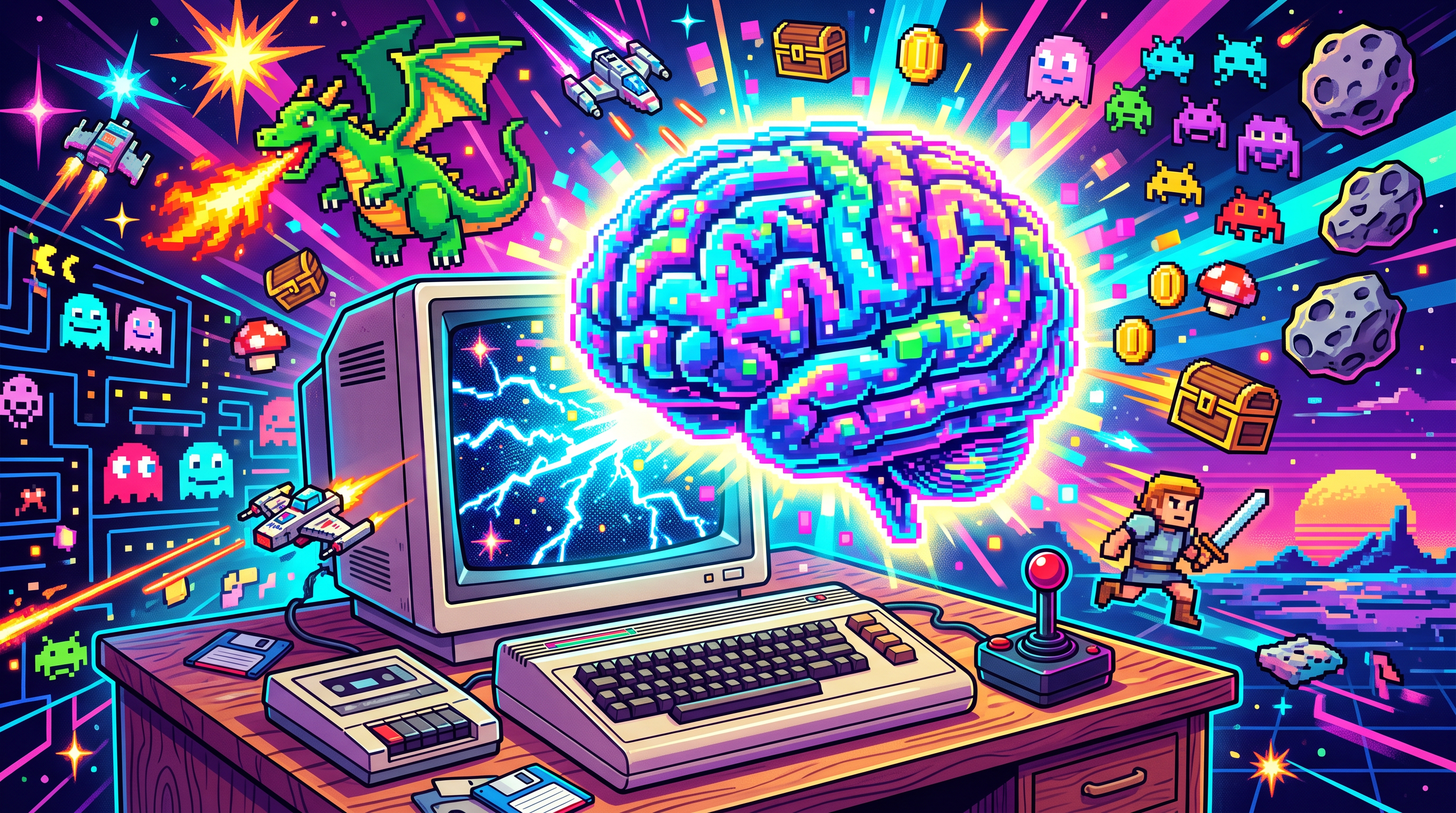
The 8-Bit Illusion, or Why the Best Graphics Card is Still Between Your Ears
Whenever someone walks past me today wearing an “I love 8-Bit” shirt featuring a massive Super Nintendo controller or a Street Fighter II motif, I usually have to smile. Technically speaking, we are already deep into the 16-bit era there. But in the mainstream, “8-bit” is no longer a technical specifier; it has become a cultural umbrella term. A nostalgic bracket for anything that has pixels, beeps, and somehow took place before the turn of the millennium.
For someone like me who rode those tech waves of the 80s and 90s live this retro romance sometimes falls a bit short. Because my reality, and that of many European computer kids, looked fundamentally different from the perfectly polished, Japanese console world of Mario and Zelda.
Computer beats Console
It’s not that I fundamentally boycotted consoles. My first digital steps actually took place on a real console: the good old Atari VCS 2600. Pitfall, River Raid, Enduro – that was the entry point. The fact that the later Japanese console culture largely passed me by wasn’t an ideological decision, but simple pragmatism. The C64 and later the Amiga 500 were simply the smarter, more flexible machines for me.
With these machines, we not only had access to an endless archive of games (partly thanks to a flourishing, decentralized piracy network on the schoolyard) but we could also actually work with the computers. We could program, try things out, create something ourselves. Why put an expensive, closed system in your room when you could have a real computer that kept all doors open?
The fact that I bought a dedicated console again years later (a PlayStation 1 for titles like Tony Hawk, Soul Blade, or Wipeout) was born more out of necessity. The PlayStation marked the establishment of the CD as a gaming medium. For work and my studies, I had switched to a Mac, but the gaming landscape there at the end of the millennium was pretty bleak. The console provided uncomplicated access for quick rounds in between.
The Graphics Card Was Between Our Ears
But back to the beginnings on C64, ZX81, Amiga, and Co: it was precisely these open systems that produced the games that define the medium for me to this day. Because if you can’t blind the people in front of the monitor with cinematic cutscenes or motion capture, you need a reliable foundation: mechanics made of steel. A game without a watertight set of rules was mercilessly sorted out back then.
The most powerful graphics card of the 80s and 90s sat right between our ears. We didn’t need HD textures to learn cutthroat capitalism in M.U.L.E. (the forefather of economy and survival games). We were still mapping the rudimentary dungeons of The Bard’s Tale by hand on grid paper. And in Elite, we traded in 1984 using a measly 64 kilobytes of RAM with vector graphics in a fully simulated universe. That was the exact blueprint for every modern space epic, built out of pure mathematics.
Add to that the combination of keyboard and joystick as an indispensable navigation tool. While console gamers hopped through linear levels, the adventure genre opened up entirely new narrative horizons for us that simply did not exist on the mainstream console market. On the C64, we painstakingly typed English text commands into atmospheric adventures like Asylum or marveled at the (then groundbreaking) graphics of The Pawn. When the point-and-click principle emerged, we initially still steered the cursor across the screen stoically with the joystick from verb to object. For me, it was less Monkey Island that struck a nerve, but rather the bizarre madness of Maniac Mansion or the (from today’s perspective, wonderfully out of time) Leisure Suit Larry.
This type of control didn’t just fuel pure puzzle games, but also the enormously atmospheric action-adventure genre. Titles like The Last Ninja or Enigma Force impressively proved how much narrative density, exploration, and tactical depth could be squeezed out of isometric perspectives. And while we’re on the subject of meticulous planning and tinkering: even slightly off the classic adventure theme, highly complex rogue simulations like They Stole A Million kept us glued to our screens for hours with their strategic heist mechanics. The fact that we initially experienced these deep, complex stories and worlds entirely without mouse controls did not diminish the fascination. The mainstream console market didn’t even know most of these milestones in video game history.
Tracker Code Instead of Virtual Pop Concerts
Audio was also in a league of its own. If it is celebrated as a major digital milestone today that pop stars like The Weeknd or Ariana Grande give virtual concerts in Fortnite, that is certainly a smart event concept. But for me, the musical pioneering work was done by the Amiga with its “Paula” chip.
Instead of artificial synthesizer beeps, the box played uncompressed audio samples. Audio geniuses like Rob Hubbard, Chris Huelsbeck, or Martin Galway coaxed massive soundtracks out of just a few tiny audio tracks. That was pure, hand-crafted code, where the difference between average and excellence lay exclusively in the artisanal attention to detail.
Physics, Iteration, and the Return of the Indie Scene
When I look at the development of the last 25 years today, a thesis inevitably forces itself upon me: the fundamental mechanical rules of gaming were already written back then, in the 80s and early 90s. Everything that followed was mainly a “faster, higher, further,” driven by rapid leaps in technology.
The last truly fundamental paradigm shifts in game design for me were the introduction of real physics engines (games like Half-Life 2, in which gravity and mass were suddenly no longer fixed scripts, but a dynamic sandbox) and the creation of open-world games (through non-linear storylines in an open 3D world, GTA III is practically the mother of the open-world genre).
Everything else was primarily technical scaling and incredible optical polish. I might let multiplayer (whether real-time or massive) count, but otherwise… we go through waves of development in which the familiar is perfected. Is that a bad thing? Absolutely not. Modern blockbusters are often fantastic, highly impressive experiences that show what is technologically feasible today.
But the beauty of it is: if I’m looking for that direct, uncorrupted mechanics-feeling of back then today—that quick, smart gameplay twist without forty hours of cinematic baggage—I don’t need to dust off an old CRT monitor anymore. A glance at platforms like Steam and the gigantic, creative indie scene is completely sufficient. It is exactly there, in the small, well-thought-out mechanics far away from multi-million dollar budgets, that the essence of the old home computer era lives on today more grandly than ever.