
(Part 2 of “Great Equalizer or Feudalism 2.0?”)
The Story So Far: The Commoditization of Cognition (Summary of Part I)
In part 1 of this article, we established that the current AI boom is far more than short-lived hype – it is a tectonic shift in our working world and society, where pure craftsmanship and flawless execution are increasingly taken for granted.
Most importantly, we placed this current development into the historical context of the last forty years. Following the personal computer (which made computation cheap) and the internet (which made distribution cheap), generative AI is now breaking through the bottleneck of cognition. The machine has learned our language and is taking over content creation and logical problem-solving at almost zero cost.
Of course, this isn’t humanity’s final major bottleneck – the ultimate “final boss” will be linking these cognitive models with robotics; the leap into the physical world (after all, even digital systems require tangible hardware, data centers, and raw materials just to exist).
But if the machine is already thinking and working for us in the digital space today – who owns the future? That is exactly where we pick up the thread.
“Access for All” or the Return of the Feudal Lords?
People often hastily deduce from this triumph of cognitive automation that AI will democratize the world. But this narrative of “access for all” is a dangerous half-truth.
There is, admittedly, an undeniable democratization of usage. The fact that a teenager in the developing world can now access an AI model entirely for free – a model whose capabilities the US military would have paid billions for a decade ago – is phenomenal.
The early internet was built on open protocols like HTTP or SMTP. It was decentralized, and barriers to entry were low. AI infrastructure, however, is the exact opposite. To train a world-leading frontier model today requires gigantic data centers, billions in venture capital, tens of thousands of GPUs, and massive amounts of energy. It is a game where perhaps only five to ten corporations worldwide are still left at the table.
The “shovel sellers” – the hardware manufacturers, cloud providers, and AI monopolists – are literally lining their pockets, while the rest of the world operates in absolute dependence on their models. The tools are distributed to the masses, but the enormous profits aren’t reaching the general public; instead, 99.9 percent flow directly back into the coffers of the new digital power brokers. It is a phenomenon that economist Yanis Varoufakis aptly describes in his recent writings as Technofeudalism.
This concentration of power is exacerbated by the fact that some of the biggest players are competing on all fronts simultaneously. Google, for example, profits from countless streams at once: they own their own AI models, the dominant mobile operating system, the app store, the search engine, and the cloud platform. Amazon is also expanding its power; even if they are strategically buying their way into the pure AI race, they dominate the infrastructure the world computes on through AWS.
To ensure the masses accept this drastic redistribution of power and capital without complaint, an ancient principle takes effect: panem et circenses (bread and circuses). What gladiator fights were to ancient Rome, the hyper-personalized content stream is today. As long as AI keeps us entertained with tailor-made dopamine hits on social media, the supply chain drops the package at our door the next day, and we are fed the illusion of the digital meritocracy (“everyone is the architect of their own fortune”), the pressure for systemic critique remains far too low.
The “Human Premium”: What Remains When Everything Can Be Simulated?
Where does this all lead? When flawless analysis, perfect code, and smart strategy become free mass commodities, we are heading toward a barbell economy – a phenomenon described by economists like David Autor regarding the polarization of the labor market and the hollowing out of the traditional middle class. On one side, we find highly automated, extremely cheap, and qualitatively consistent standard services. On the other side, the “Human Premium” emerges.
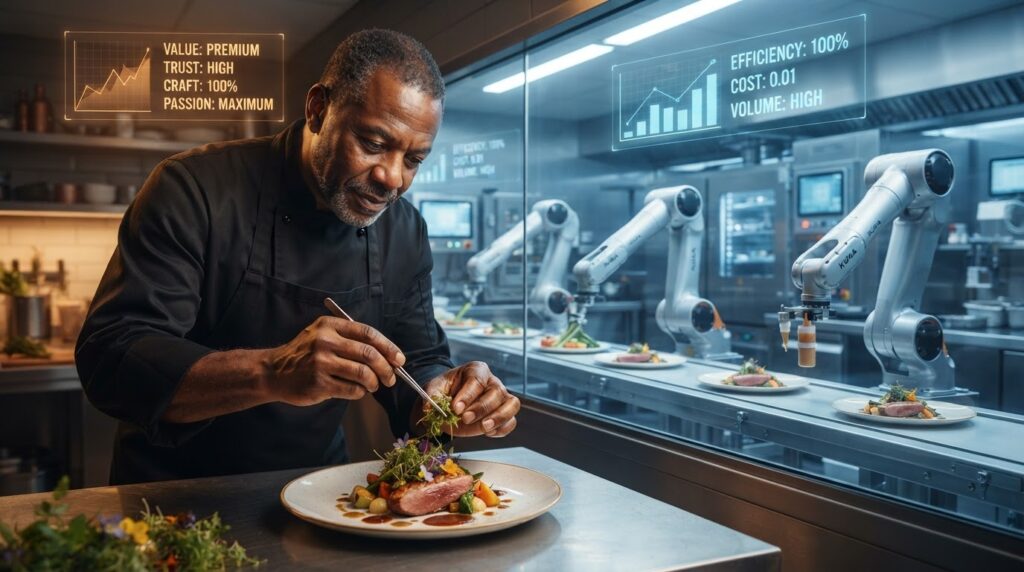
Take the example of a true top chef. In the kitchen of the future, the chef will have long since outsourced the “menial” tasks to robotics and AI. Hours of chopping onions, precise sous-vide cooking, inventory management – the system handles all of that. The human steps into the role of creative director. Why? Because in a world where everything perfect, flawless, and scalable is done by machines, human imperfection, effort, and authenticity become the ultimate new status symbol. We don’t just pay the top chef for the calories on the plate, but for their story, their craft, and the knowledge that a sentient being invested passion into it.
This principle applies far beyond gastronomy. When implementing VoiceBots for customer service, I see daily just how advanced the technology is. The AI understands context, reacts at lightning speed, and is infinitely patient. But when a quick change needs to be made or something out of the ordinary needs to be resolved, nobody on the phone wants to hear a perfectly calibrated, synthetic voice de-escalating with artificial empathy.
In real crises, we seek out humans because a machine cannot take responsibility. An AI feels no shame when it fails. It has no reputation to lose. It doesn’t sleep poorly when a customer is dissatisfied. The irreplaceable human niche of the future no longer lies in pure cognitive performance, but in having “Skin in the Game” (as philosopher and risk expert Nassim Nicholas Taleb puts it). It is the emotional glue and accountability – sometimes mere human presence – that create genuine trust.
As a society, we must prepare for the fact that simply regurgitating knowledge will soon be worthless. The new leading currencies are intentionality, taste, resilience, and empathy. The decisive question will no longer be how we compute a solution – but why we are looking for it in the first place.
42, if you know what I mean. What was the question again?