
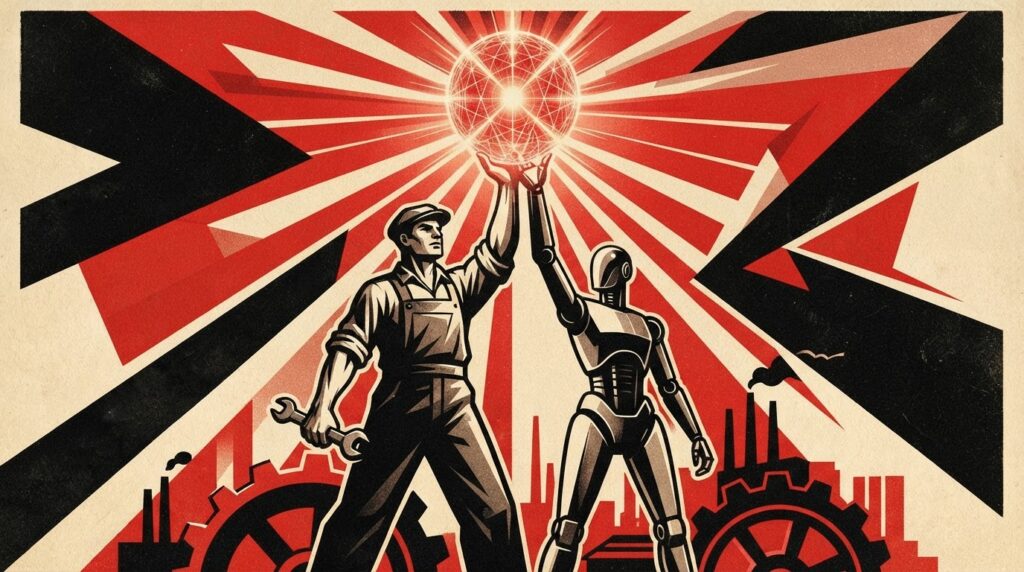
AI: Great Equalizer or Feudalism 2.0?
When you stand in the engine room of technological development every day, working intensively with AI models, the noise surrounding the alleged “AI hype” fades surprisingly fast. Anyone still dismissing this as a mere trend is confusing the chaotic gold rush on the surface with the tectonic shift happening inexorably beneath it. We are witnessing the dawn of a new epoch.
Yet the most pressing question, hovering above all the fascinating demos and product launches, remains frighteningly unanswered: Who does this technology ultimately serve? Is Artificial Intelligence the great societal equalizer, gifting us all unprecedented opportunities – or are we witnessing the birth of a new, digital feudalism, wrapped in the shiny illusion of limitless feasibility? A deeper look at historical parallels and socio-cultural mechanisms reveals a complex, somewhat grim picture of our immediate future.
The Red Queen Effect: When the Baseline Skyrockets
In evolutionary biology, there is a concept introduced by biologist Leigh Van Valen in 1973 that translates perfectly to our modern labor market: the Red Queen hypothesis (or the Red Queen effect). Inspired by Alice in Wonderland, this principle states that you have to run as fast as you can just to stay in the same place. The reason? The environment and the competition are constantly evolving as well. When everyone suddenly has access to the exact same groundbreaking tools, past performance is no longer enough to stand out – you have to push yourself harder and harder just to maintain the status quo. This is exactly the dynamic we are currently experiencing in knowledge work.
Recently, a friend – a truly excellent developer – told me that he hardly types a single line of original code himself anymore. Instead, he directs the AI, formulates requirements, discards potential solutions, and orchestrates the interplay of the generated code blocks. He uses the machine as a cognitive exoskeleton. The actual craft of programming has become secondary to him.
What does this mean for the rest of us? When everyone has on-demand access to a brilliant programmer, a world-class copywriter, or a strategic analyst right in their pocket, the sheer craft of execution loses its value as a unique selling proposition overnight. A flawless email, a solid piece of standard code, or a well-structured business plan are no longer top-tier achievements. They are the absolute bare minimum, the ticket of admission just to stay in the game. The floor – the “base level” for acceptable work – is being massively raised by AI. But the ceiling, what can actually be achieved, is rising to unprecedented levels for those who are already experts and know how to use AI as a lever. In the end, the winner of this rat race won’t be the one who knows how to operate the machine, but the one who can best evaluate, curate, and translate its output into a real-world business context.
Three Epochs of Technology: From Computation to Cognition
To understand why AI will alter our societal fabric more fundamentally than any invention since the steam engine, it helps to look at General Purpose Technologies – an economic term for baseline innovations that reshape entire societies. Over the past forty years, we have traversed three decisive epochs, best defined by what they each managed to massively cheapen and scale for the masses.
- The First Epoch: Cheapening Computation The first epoch began in the late 1970s with the Personal Computer. The PC revolutionized the world by cheapening computation. Processing power was no longer centralized in massive mainframes; it arrived on the individual’s desk. But there was a massive catch: humans had to learn the language of the machine. We had to type DOS commands, click, and adapt to rigid interfaces. Moreover, for most of us, whatever we created remained isolated. We programmed away on our PCs, and that was it. The bottleneck was distribution. Only the very few managed to “scale” – and ultimately, those weren’t necessarily always the best.
- The Second Epoch: Cheapening Distribution It took a while, but with the internet, we entered the second epoch: the dot-com boom of the 90s. The internet cheapened distribution to near zero. Suddenly, information, texts, and videos could be shared globally in milliseconds. The nervous system of the world was born. Yet, here too, a bottleneck remained: production. The web could send your text to Tokyo for free, but you still had to sit down and write it yourself. The convenient workaround for this was human vanity. People want to present themselves and produce “content” even without direct compensation. It would take a while for the species of the “content creator” to fully evolve, but even without them, the internet’s content grew exponentially. Unintentionally, this laid the groundwork for the next evolutionary leap.
- The Third Epoch: Cheapening Cognition Today, in the third epoch, Artificial Intelligence is attacking exactly this last bottleneck. AI is cheapening cognition. The creation of content, the recognition of patterns, and the solving of standardized problems cost next to nothing anymore. And the most fascinating part? For the first time in human history, man no longer has to learn the language of the machine to harness its potential. The machine has learned our language. And to throw in a slightly old-school music quote: “Get Ready! Get Ready! ’cause here I come!” (Sunny Domestoz). This is going to be fun… More on that in part two.